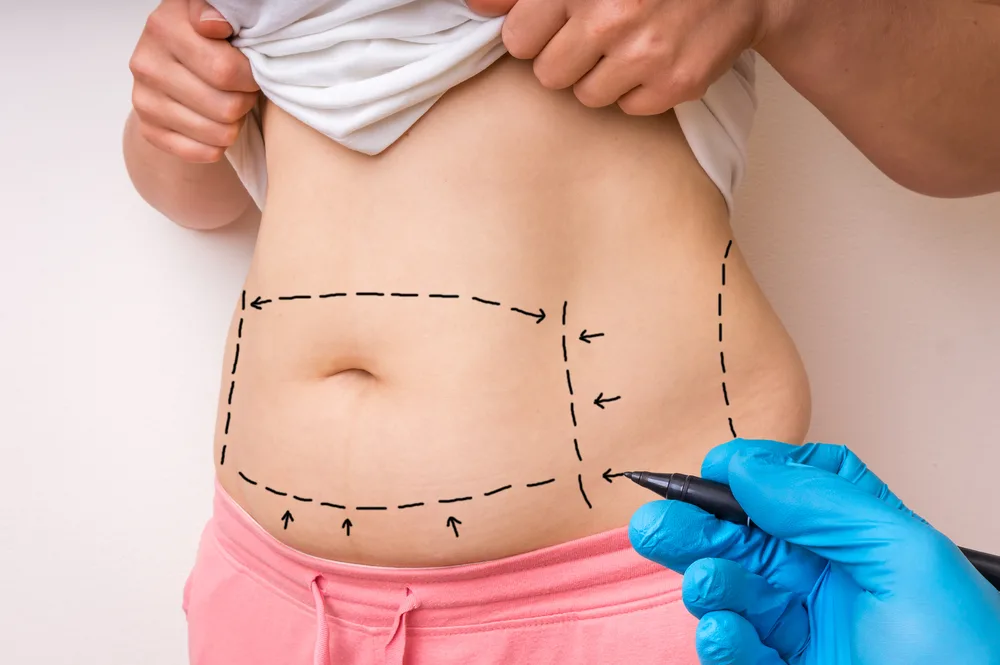
You can strengthen your core, maintain a healthy weight, and still have an abdomen that doesn’t reflect your effort. Pregnancy may leave stretched skin and separated abdominal tissue. Weight loss can reduce body size without allowing the skin to contract around the new shape. Genetics and aging can also create stubborn fat around the waist, even when the rest of the body remains proportionate.
Liposuction and tummy tuck surgery address different parts of these concerns. Liposuction reduces localized fat, while a tummy tuck removes excess abdominal skin and may repair weakened or separated tissue beneath it. When both fat and loose skin affect the midsection, a carefully coordinated approach may create a smoother transition across the abdomen, waist, and surrounding contours. The correct plan depends on what is causing the shape you see, not simply on which procedure sounds more appealing.
At Women’s LifeCenter Aesthetic Surgery and Medispa, Elysa Fisher, MD, FACS, begins with a detailed evaluation of your skin, fat distribution, abdominal wall, previous scars, weight history, and personal goals. Dr. Fisher offers tummy tuck surgery as well as SmartLipo Triplex, a laser-assisted fat reduction procedure used for selected areas of localized fat and skin laxity. She will help you understand whether your concerns are best addressed with skin removal, abdominal repair, targeted fat reduction, or a personalized combination.
Schedule a Complimentary Consultation
When Exercise Can’t Correct the Full Problem
Many clients considering abdominal contouring have already done the hard work. They may exercise several times a week, make thoughtful food choices, and maintain a weight that feels healthy and sustainable. Still, a lower abdominal fold may remain, the waist may lack definition, or loose skin may gather above pants and fitted clothing. These concerns often persist because muscle, fat, and skin respond differently to weight loss and exercise.
Exercise can strengthen the abdominal muscles, but it cannot remove skin that has lost its elasticity. It also cannot directly repair stretched connective tissue along the center of the abdomen. Likewise, weight loss can make fat cells smaller, yet it may not eliminate every localized deposit around the abdomen or flanks. This is why two people at the same weight can have very different abdominal shapes.
Our clients often describe the concern through ordinary moments rather than medical terms. One may feel a ledge above a C-section scar that never improved despite years of exercise. Another may be able to see strong abdominal muscles beneath skin that folds when she sits. Someone else may like the front of her abdomen but feel that fullness at the waist prevents clothing from following her natural shape.
Dr. Fisher’s own clients have shared this type of experience. One tummy tuck client described living for years with a persistent ledge after two C-sections that did not improve with exercise. She also recalled feeling at ease during her consultation and valued that Dr. Fisher noticed and addressed a healing concern during follow-up care.
What Is the Difference Between Liposuction and a Tummy Tuck?
Liposuction and tummy tuck surgery are both body-contouring procedures, but they do not perform the same job. Liposuction removes selected deposits of fat through a narrow instrument called a cannula. It works best when localized fat is the main concern and the surrounding skin has enough elasticity to adjust to the reduced volume. It does not remove a significant amount of hanging skin or repair separated abdominal tissue.
A tummy tuck, also called abdominoplasty, removes excess abdominal skin and fat through a lower abdominal incision. In many cases, it also allows weakened or separated abdominal tissue to be tightened. The remaining skin is then repositioned to create a smoother and firmer abdominal profile. A tummy tuck is more extensive than liposuction because it addresses structures that fat removal alone cannot change.
The simplest way to understand the difference is to identify what would remain if the fat were reduced. If the skin is firm and the abdomen has good internal support, fat reduction may be enough to improve the contour. However, if the skin already hangs, folds, or appears stretched, removing fat alone may leave that skin unsupported. If both problems are present, treating only one may create an incomplete result.
When Liposuction May Be Enough
Liposuction may be considered when the primary concern is localized fat rather than loose skin. A client may be close to her preferred weight but have fullness across the lower abdomen, waist, love handles, or another area that remains resistant to diet and exercise. The skin should be reasonably firm and elastic because it must adapt to the smaller volume beneath it. Better skin elasticity generally supports a smoother result.
Liposuction is not a weight-loss procedure or a treatment for obesity. It is intended to refine specific areas and improve proportion. Removing a limited fat deposit may help the waist look more defined or allow clothing to follow the torso more smoothly. However, the procedure cannot promise a particular clothing size or a perfectly flat abdomen.
Skin quality is especially important after pregnancy or major weight loss. Stretch marks, thin skin, and existing laxity may indicate that the skin will not contract well after fat removal. In those situations, Dr. Fisher may recommend a tummy tuck or another approach instead of relying on liposuction alone. Choosing a less extensive treatment is only useful when it can create the improvement you actually want.
SmartLipo Triplex at Women’s LifeCenter
Women’s LifeCenter offers SmartLipo Triplex for selected areas of localized fat and skin laxity. This laser-assisted lipolysis procedure uses a small cannula containing a laser fiber. According to the practice’s current treatment information, the system delivers energy through three wavelengths to disrupt targeted fat while also supporting changes in the overlying skin. Treatment areas may include the abdomen, love handles, arms, thighs, chin, and neck.
SmartLipo Triplex may be useful when fat is the main concern and the skin does not require surgical removal. However, it should not be viewed as a replacement for abdominoplasty when there is substantial hanging skin or meaningful abdominal separation. Laser-assisted treatment can support contouring, but it cannot remove a wide fold of stretched tissue. Dr. Fisher will explain where a minimally invasive option ends and where surgery becomes more appropriate.
The best treatment is not automatically the newest or least invasive one. A smaller procedure that cannot correct the underlying problem may lead to disappointment and additional treatment later. Conversely, a full tummy tuck may be more surgery than someone needs when the skin remains firm and the concern is a limited pocket of fat. The consultation allows those differences to be evaluated before you commit to a procedure.
When a Tummy Tuck May Be the Better Choice
A tummy tuck may be appropriate when loose skin, abdominal weakness, or separation contributes significantly to the shape of the midsection. Pregnancy is a common cause because the skin and deeper supporting tissues expand to accommodate the growing uterus. Major weight fluctuations and aging can create similar changes. Prior abdominal surgery may also influence the way skin and tissue sit across the lower abdomen.
The procedure may improve a lower abdominal overhang, skin that folds above clothing, and a rounded appearance caused partly by weakened tissue. It can also remove selected stretch marks when those marks are located within the skin being excised. Stretch marks outside that area generally remain, although their position may change as the skin is repositioned. A tummy tuck should therefore be viewed as contouring surgery rather than a complete treatment for every mark or surface irregularity.
Tummy tuck surgery leaves a permanent lower abdominal scar. The incision is usually placed low enough to be concealed by many styles of underwear and swimwear, but its length depends on how much skin needs to be removed. More extensive laxity often requires a longer incision. Dr. Fisher will explain the expected scar before surgery so the tradeoff is clear.
Why Liposuction and Tummy Tuck Surgery May Be Combined
A tummy tuck primarily improves loose skin and abdominal structure, but it may not fully address fat around the waist or neighboring areas. Targeted fat reduction can sometimes improve the transition between the treated abdomen and the surrounding torso. This may create greater waist definition and help the final contour look balanced from the front, side, and angled views. The purpose is not to remove as much fat as possible, but to address areas that would otherwise remain out of proportion.
For example, a client may have stretched lower abdominal skin as well as fullness at the flanks. A tummy tuck could improve the front of the abdomen, while targeted fat reduction may help the waist blend more smoothly into the hips and back. Another client may need significant skin removal but have very little surrounding fat, making additional liposuction unnecessary. Every component should have a specific reason for being included.
Combining procedures can also increase surgical demands, so more treatment is not automatically better. The total amount of surgery, medical history, circulation, tissue quality, and postoperative mobility must all be considered. In some cases, Dr. Fisher may recommend limiting the areas treated or separating procedures into stages. Safety and predictable healing take priority over completing every possible correction at one time.
What Can Combined Abdominal Contouring Improve?
A coordinated abdominal contouring plan may address several concerns at once, but results depend on anatomy, skin quality, healing, and the procedures performed. Dr. Fisher will explain which changes are realistic for your body and which may remain. The goal is meaningful improvement in shape and proportion, not a digitally perfect abdomen.
Treatment may be considered for:
- Loose skin after pregnancy or weight loss
- A lower abdominal fold or overhang
- A ledge above a C-section scar
- Localized fat across the abdomen or waist
- Love handles that interrupt waist definition
- Stretched or weakened abdominal tissue
- A protruding appearance that remains at a stable weight
- Clothing that pulls or gathers around the midsection
- Selected stretch marks within the skin being removed
- An abdominal shape that does not reflect an active lifestyle
Neither procedure is designed to produce major weight loss. The amount shown on the scale may change because tissue is removed, but the real purpose is contour. Clients usually achieve the most predictable results when they are already near a stable weight they can realistically maintain.
Am I a Candidate for Liposuction and Tummy Tuck Surgery?
A suitable candidate is generally in good overall health, near a stable weight, and bothered by abdominal concerns that have not improved through diet and exercise. You should understand that tummy tuck surgery creates a permanent scar and requires a meaningful recovery. You must also be able to follow restrictions on lifting, exercise, work, childcare, and household tasks. Future plans for pregnancy or major weight loss should be discussed because either can alter the result.
You may be ready to discuss abdominal contouring if:
- Your weight has remained reasonably stable
- Loose skin or localized fat continues to bother you
- You are not using surgery as a substitute for weight loss
- You understand that liposuction does not repair loose skin
- You accept the permanent scar required for a tummy tuck
- You can stop nicotine use as directed
- You can arrange dependable help during recovery
- You have realistic goals for improvement
- You are not planning another pregnancy soon
Nicotine use is an important safety concern because it reduces blood flow to healing tissue. Smoking, vaping, nicotine pouches, and other nicotine products may increase the risk of wound complications, infection, and skin loss. Medical conditions, medications, circulation problems, prior blood clots, previous abdominal surgery, and healing history also affect candidacy. Complete honesty during the consultation helps Dr. Fisher plan responsibly.
Your Consultation With Dr. Elysa Fisher
Your consultation begins with what you see, what you feel, and how the concern affects your life. Dr. Fisher will ask about pregnancies, C-sections, weight changes, exercise, previous procedures, medical conditions, medications, and future plans. She will also want to understand whether your priority is a flatter abdomen, greater waist definition, removal of hanging skin, muscle support, or a combination of goals.
During the examination, Dr. Fisher evaluates skin elasticity, fat distribution, abdominal scars, tissue laxity, muscle structure, and overall body proportions. She may ask you to stand, sit, or gently tighten the abdomen because different concerns become visible in different positions. A fold that appears while sitting may behave differently from loose skin that hangs while standing. The waist and flanks are also considered so treatment does not focus too narrowly on the front of the abdomen.
Dr. Fisher completed her undergraduate, graduate, and postgraduate education at Northwestern University. She became board-certified in plastic and reconstructive surgery in 1992 and has spent decades providing surgical and non-surgical aesthetic care. She describes her role as being accessible and serving as a source of information so clients can understand the full range of available options.
That approach is particularly valuable when comparing liposuction and tummy tuck surgery. The easiest-sounding procedure may not be the one that solves the concern, while the most extensive operation may not be necessary. Dr. Fisher will explain what each option can accomplish, where its limitations begin, and why she is recommending one path over another.
What Happens During the Procedure?
The exact procedure depends on the individualized surgical plan. Tummy tuck surgery is generally performed under anesthesia and begins with a lower abdominal incision. The skin and underlying tissue are carefully elevated, and weakened or separated abdominal tissue may be tightened when appropriate. Excess skin is then drawn downward and removed.
During a full tummy tuck, the belly button usually remains attached to its underlying stalk while the surrounding skin is repositioned. A new opening is created so the navel can appear through the tightened skin. Dr. Fisher considers its shape and position because the belly button has an important effect on whether the abdomen looks natural. The lower incision is then closed in layers.
When targeted fat reduction is part of the plan, a cannula is introduced through small access points to treat selected areas. The goal is to improve transitions and proportion without creating unnecessary tissue trauma. The amount and location depend on the blood supply, skin quality, and the overall surgical plan. Dressings, a compression garment, and temporary drains may be used depending on the procedure.
Recovery After Liposuction and Tummy Tuck Surgery
Recovery is usually guided by the tummy tuck because it is the more extensive part of a combined plan. Tightness, swelling, bruising, soreness, numbness, and fatigue are expected during the early period. You may initially walk slightly bent because the abdominal skin and internal repair feel tight. Standing fully upright generally becomes easier as healing progresses.
Temporary drains may be used to remove fluid that collects beneath the skin. You will receive instructions for emptying them, recording output, and caring for the entry points. Compression may also be recommended to support the tissues and manage swelling. Follow Dr. Fisher’s instructions rather than substituting advice from another person’s recovery.
Gentle walking is often encouraged because movement supports circulation, but lifting and strenuous activity must be avoided. Parents need help with babies and young children because picking them up can strain the abdominal repair. You may also need assistance with laundry, groceries, pets, cleaning, and other tasks that involve reaching, bending, or carrying.
Liposuction recovery guidance commonly describes significant activity limits during the first week, improvement during weeks two and three, and a gradual increase in activity after swelling begins to settle. Tummy tuck recovery varies more according to the extent of skin removal and muscle repair. Dr. Fisher will provide a personalized return-to-work and exercise timeline based on your surgery and healing.
Scars, Swelling, and Final Results
A tummy tuck creates a permanent lower abdominal scar, while liposuction uses smaller access incisions. The larger scar is generally planned where it can be covered by common underwear or swimwear, although clothing styles differ and concealment cannot be guaranteed. It may begin pink, firm, raised, or darker than the surrounding skin. Over time, most scars soften and fade, but they do not disappear completely.
Swelling may temporarily make the abdomen and waist look larger or less even than expected. One area may settle sooner than another, and the tissues can feel firm or numb during early healing. These changes do not necessarily represent the final result. Abdominal contour and scar appearance continue developing for months.
The fat cells removed through liposuction do not return in the ordinary sense, and skin removed during a tummy tuck does not grow back. However, remaining fat cells can enlarge with weight gain, and the remaining skin can stretch. Pregnancy and major weight changes may significantly alter the result. Maintaining a reasonably stable weight helps protect the new contour.
Risks and Important Considerations
Liposuction and tummy tuck surgery both carry risks. Possible liposuction complications include bruising, fluid accumulation, infection, changes in sensation, irregular contours, asymmetry, loose or rippled skin, damage to deeper structures, blood clots, and the need for revision surgery. Thermal injury is also a recognized concern with certain energy-assisted techniques.
Tummy tuck risks include bleeding, infection, seroma, poor wound healing, fat necrosis, numbness, persistent pain, unfavorable scarring, skin loss, asymmetry, recurrent looseness, blood clots, and the possibility of revision surgery. Combining procedures may create additional considerations because more tissue is being treated and recovery may be more demanding. These risks must be weighed against the expected benefit for your individual anatomy and health.
No responsible surgeon can promise a perfect result or a complication-free recovery. Following activity restrictions, attending follow-up visits, avoiding nicotine, and reporting concerns promptly are important parts of care. Contact the office for sudden swelling, worsening pain, unusual drainage, fever, skin color changes, shortness of breath, chest pain, or another symptom listed in your postoperative instructions.
Why Choose Dr. Elysa Fisher for Abdominal Contouring in Wilmette?
Dr. Fisher brings the perspective of a board-certified plastic surgeon who offers surgical and minimally invasive body-contouring options. Her Northwestern education and decades of experience allow her to evaluate the skin, fat, muscle, scars, and overall proportions together. This matters because an abdomen that looks full may require very different treatment depending on which tissue is creating that appearance.
Women’s LifeCenter Aesthetic Surgery and Medispa was created as a supportive environment where women can explore options throughout different stages of life. The practice brings surgical and non-surgical aesthetic care together so clients are not limited to one type of treatment. Dr. Fisher’s philosophy emphasizes accessibility, education, and helping women understand possibilities they may not have realized were available.
Clients repeatedly describe Dr. Fisher as detailed, compassionate, and willing to answer their questions. They also describe the office and staff as welcoming, calm, and attentive to individual concerns. That experience matters when the decision involves permanent scars, significant recovery, and a part of the body that may carry years of frustration or self-consciousness.