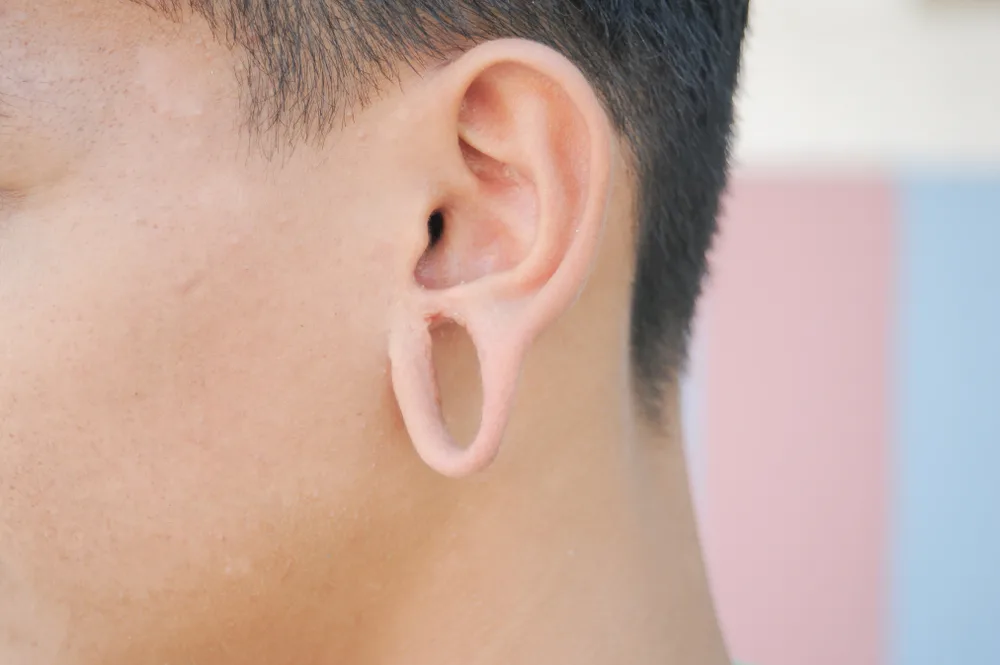
An earlobe can change gradually or tear in a single moment. Years of wearing heavy earrings may stretch a piercing into a long vertical opening, while an accidental pull can split the tissue completely. Gauges, multiple piercings, aging, and piercings placed too close to the lower edge can also leave the lobe elongated, uneven, or unable to support jewelry safely.
Earlobe repair, also called lobuloplasty, is a minor surgical procedure that restores the shape and strength of a torn, split, or stretched earlobe. The damaged opening is carefully removed, the remaining tissue is reshaped, and the edges are closed to create a more natural contour. The procedure can often be completed in the office using local anesthesia, allowing you to return home shortly afterward.
At Women’s LifeCenter Aesthetic Surgery and Medispa, Elysa Fisher, MD, FACS, considers more than simply closing the visible opening. She evaluates the amount of healthy tissue remaining, the shape of the opposite earlobe, the position of previous piercings, your tendency to form scars, and whether you hope to wear earrings again. Her goal is to restore a balanced lobe that looks natural beside your face and has enough support for future jewelry when healing is complete.
Schedule a Complimentary Consultation
When an Earlobe Changes How You Wear Jewelry
A stretched piercing may begin as a small change that is easy to overlook. Over time, the opening can become longer, the lower border of the lobe may become thinner, and an earring may begin tilting downward instead of facing forward. You may stop wearing certain earrings because they no longer sit properly or because you worry the remaining tissue could tear completely.
A sudden injury can create a different experience. An earring may catch on clothing, a hairbrush, a telephone headset, or a child’s hand and pull through the lower edge of the lobe. Some tears heal with separated edges, while others leave an uneven notch or a scar that changes the lobe’s shape. Heavy earrings, oversized gauges, accidental snags, multiple piercings placed close together, and direct trauma are all recognized causes of stretched or split earlobes.
The concern may be cosmetic, practical, or both. You may dislike the visible opening even when you aren’t wearing jewelry, or you may simply want to wear earrings without adhesive supports and constant worry. Earlobe repair can close the damaged area and recreate a fuller lower border, although the procedure will leave a small permanent scar.
What Is Earlobe Repair?
Earlobe repair is surgery performed on the soft lower portion of the outer ear. It can close an elongated piercing, reconnect a completely split lobe, remove stretched tissue left by gauges, or reshape a lobe altered by trauma or poorly positioned piercings. The medical term lobuloplasty refers specifically to reconstructing or reshaping this earlobe tissue.
The operation generally involves removing the thin layer of healed skin lining the tear or opening. Fresh tissue edges are then brought together so they can heal as one continuous earlobe. Dr. Fisher may close the area in layers to support the deeper tissue and reduce tension on the visible skin. More complex cases can require tissue rotation, flap rearrangement, or another reconstructive technique when a straightforward closure would leave the lobe too small, uneven, or distorted.
Earlobe repair does not reshape the cartilage of the upper ear or change how far the entire ear projects from the head. Those concerns are addressed through otoplasty rather than lobuloplasty. Dr. Fisher will determine whether your concern is limited to the soft lobe or involves the broader size, position, or shape of the external ear.
What Can Earlobe Repair Address?
Earlobe damage does not look the same in every client. One person may have a piercing that has stretched only a few millimeters, while another may have a complete split extending through the lower edge. Gauged earlobes can leave a large circular opening and excess hanging tissue that requires more extensive reshaping.
Earlobe repair may be considered for:
- A piercing hole that has become long or stretched
- A partial tear with a thin bridge of tissue remaining
- A complete split through the lower edge of the lobe
- Enlarged openings left after removing gauges
- Multiple piercing holes placed too close together
- A piercing positioned too close to the bottom of the lobe
- An irregular notch caused by an earlier injury
- Uneven earlobes following previous repair
- Drooping or elongated earlobe tissue
- Damage caused by an earring being pulled or caught
Repair can improve symmetry, but no procedure can guarantee that the two lobes will become identical. Earlobes naturally differ in size, attachment, thickness, and position before surgery. Dr. Fisher will explain which differences can be corrected and which are likely to remain after healing.
Repairing a Stretched Piercing Hole
An elongated piercing often develops slowly as the weight of an earring pulls downward against the soft tissue. The opening may begin looking like a line rather than a round hole, and the strip of skin beneath it can become increasingly thin. Continuing to wear heavy jewelry may eventually convert a partial tear into a complete split.
A mildly stretched hole will not always require the same repair as a fully torn lobe. Dr. Fisher may remove the elongated tract and close the tissue while preserving the natural lower contour. The existing piercing is generally closed rather than left open because the damaged edges have already healed with skin lining the channel.
The repaired lobe may be pierced again after it has developed enough strength, but the new hole should not pass directly through the scar. Scar tissue may not provide the same support as healthy earlobe tissue. The position of a future piercing should therefore be planned with enough distance from the repaired area and the lower edge.
Repairing a Completely Split Earlobe
A complete split occurs when the piercing or injury extends through the bottom of the earlobe. The two sides may heal separately, leaving a visible gap that divides the lobe. This type of injury generally will not reconnect on its own once the edges have healed with skin.
During repair, Dr. Fisher removes the healed lining from both sides of the split and recreates fresh wound edges. The tissue is then carefully aligned and closed to restore the curve of the lower lobe. Precise alignment matters because even a small step or notch can remain visible along the bottom edge after healing.
A new tear should receive prompt medical evaluation, especially when there is uncontrolled bleeding, contamination, missing tissue, or another injury to the ear. Some fresh injuries may be repaired urgently rather than waiting for the edges to heal apart. Cleveland Clinic notes that traumatic earlobe injuries may require treatment in an urgent care facility or emergency department when immediate care is indicated.
Repair After Gauges
Gauges deliberately stretch the earlobe piercing to accommodate increasingly large jewelry. After the gauge is removed, a small opening may shrink over time, but a larger opening can remain permanently stretched. The lobe may appear thin, elongated, or divided by a circular hole that does not close on its own.
Gauge repair is often more involved than closing a narrow piercing. Excess tissue may need to be removed or rearranged so the lobe does not look folded, pointed, or unusually long. Dr. Fisher must preserve enough healthy tissue to create a smooth border while balancing the repaired lobe with the opposite side.
The final scar pattern depends on the size of the opening and the amount of tissue distortion. A larger gauge may require a longer or less linear incision than a simple split-lobe repair. You should understand the likely scar and shape before deciding whether the expected improvement is worthwhile.
Earlobe Repair Versus Otoplasty
Earlobe repair treats the fleshy lower portion of the ear. It is designed for concerns such as torn piercings, stretched holes, gauge damage, and irregular lobe contours. It does not reposition the cartilage or bring prominent ears closer to the head.
Otoplasty is a different operation that reshapes or repositions the cartilaginous external ear. It may be used when the ears project farther from the head, lack a natural fold, or have another structural difference. Cleveland Clinic notes that a surgeon may recommend otoplasty instead when the client’s goal involves the overall shape, position, or size of the ears rather than an isolated earlobe injury.
Some clients have both concerns, but they do not always need to be treated together. Dr. Fisher will examine the entire ear so the recommendation matches the structure that actually bothers you. A lobe-only procedure is often enough when the upper ear already has a balanced shape and position.
Am I a Candidate for Earlobe Repair?
A suitable candidate generally has a healed tear, stretched piercing, gauge opening, or another earlobe concern that can be improved surgically. The surrounding tissue must be healthy enough to hold sutures and support the reconstructed contour. You should also understand that the procedure closes the current piercing and creates a permanent scar.
You may be ready to discuss earlobe repair if:
- Your piercing has become elongated or unstable
- The lobe has partially or completely split
- You no longer want a gauged opening
- Earrings tilt forward or pull against thin tissue
- The appearance of the lobe bothers you without jewelry
- You want to consider re-piercing after healing
- You can avoid earrings and pressure during recovery
- You understand that the two lobes may not become identical
- You can stop nicotine use as directed
- You have realistic expectations about scars and shape
Your health history can affect healing even though this is a smaller procedure. Dr. Fisher needs to know about diabetes, bleeding problems, immune conditions, previous infections, medications, supplements, nicotine use, allergies, and a history of thick or keloid scars. Plastic surgery guidance for earlobe repair also emphasizes evaluating the health of the surrounding tissue, the size of the tear, and medical factors that may interfere with wound healing or increase bleeding.
Your Consultation With Dr. Elysa Fisher
Your consultation begins with how the earlobe changed and what you want to do after repair. Dr. Fisher will ask whether the opening stretched gradually, tore during an accident, resulted from gauges, or has been repaired before. She will also want to know whether you hope to wear small studs, heavier earrings, or no jewelry after healing.
Dr. Fisher examines the thickness and flexibility of the remaining tissue, the location of the tear, the lower border of the lobe, previous scars, and the shape of the opposite ear. A complete split may require a different closure from a long but incomplete piercing. A gauged lobe may need tissue rearrangement rather than a simple straight-line repair.
The consultation also gives you an opportunity to discuss scar placement, suture care, expected swelling, and future piercing. Dr. Fisher can show you why the repaired scar may be longer than the visible opening and explain how the lower contour will be reconstructed. The goal is for you to understand the tradeoff between closing the damaged area and creating a new surgical scar.
Dr. Fisher completed her undergraduate, graduate, and postgraduate education at Northwestern University and was certified in plastic surgery in 1992. She offers both in-office procedures and more extensive surgery while emphasizing safe care, accessibility, and clear information throughout treatment.
Preparing for Earlobe Repair
Preparation is usually straightforward, but you should still provide a complete medication and health history. Certain medicines and supplements may increase bleeding, although you should never stop a prescribed medication unless the clinician managing it approves the change. Nicotine and tobacco use should also be disclosed because they can interfere with wound healing.
Remove earrings and other jewelry from the affected lobe before the procedure. Avoid repeatedly manipulating the tear or trying to hold it together with household glue or another product. If the tissue is irritated or infected, treatment may need to wait until the skin is healthy enough for surgical closure.
You may want to wear a button-front or wide-neck shirt on the day of treatment. This reduces the chance of catching the repaired lobe while pulling clothing over your head. Long hair should also be kept away from the surgical area according to the instructions provided by the office.
What Happens During Earlobe Repair?
Earlobe repair is commonly performed as an outpatient office procedure using local anesthesia. The area is cleaned, and a small injection numbs the earlobe while you remain awake. You may feel the brief pinch or sting of the anesthetic, but the repaired tissue should not feel sharp pain during the procedure.
Dr. Fisher removes the healed skin lining the split or stretched opening. Excess, scarred, or distorted tissue may also be adjusted so the remaining edges can form a natural lobe. The tissue is then closed, often in layers, using small sutures that support the deeper repair and align the skin.
A straightforward repair often takes less than an hour, although the time depends on whether one or both ears are treated and how complex the reconstruction is. Gauge closures and revision procedures may require additional tissue shaping. You can usually return home shortly after treatment.
Recovery After Earlobe Repair
Mild soreness, swelling, bruising, sensitivity, or temporary numbness can occur after the anesthetic wears off. These effects generally begin improving within the first several days. Many clients can return to nonphysical work and ordinary routines soon after the procedure, provided they protect the repaired ears from pulling and pressure.
Tiny removable or dissolving stitches may be used. When removal is required, it commonly occurs approximately one to two weeks after surgery. Complete tissue healing takes longer, even when the surface appears closed and the sutures have been removed.
Keep the incision clean according to Dr. Fisher’s instructions and avoid makeup, hairspray, hair tools, headphones, helmets, and clothing that could catch on the lobe. Swimming and submerging the ear should wait until the incision has healed sufficiently. Cleveland Clinic also advises being careful with hairbrushes and clothing, since an accidental snag can place force on the new closure.
Contact the office for increasing pain, spreading redness, warmth, unusual drainage, fever, prolonged swelling, or another symptom identified in your instructions. Do not remove sutures, pull at crusting, or apply an unapproved product to the incision. Early evaluation can determine whether a change is expected or requires treatment.
Earlobe Repair Scars
Every earlobe repair creates a permanent scar. With a straightforward split, the scar usually follows the line where the two tissue edges were joined. A gauge repair or complex reconstruction may produce a different scar pattern because more tissue must be removed or repositioned.
The scar may initially appear pink, red, dark, firm, or slightly raised. It generally softens and becomes less noticeable as it matures, but it will not disappear completely. Cleveland Clinic notes that the final appearance depends partly on skin type, while ASPS guidance explains that most clients accept a subtle scar as the tradeoff for restoring the shape of a torn lobe.
Tell Dr. Fisher if you have previously developed keloids or thick scars, particularly on the ears, chest, shoulders, or neck. Earlobes can develop raised scars after surgery or piercing in susceptible clients. Your scar history may change the recommended treatment, aftercare, or whether elective repair is appropriate.
Can I Pierce My Ears Again?
Many clients can have the repaired lobe pierced again after it has healed and developed enough strength. The waiting period should be determined by Dr. Fisher because the extent of repair and individual healing vary. Cleveland Clinic describes an average waiting period of approximately three to six months, while ASPS guidance also commonly recommends waiting at least three months.
The new piercing should not pass directly through the repair scar. Cleveland Clinic and ASPS guidance recommend placing it at least 3 millimeters from the treated site so it passes through healthier tissue. The piercing must also remain far enough above the lower edge to leave a supportive bridge of earlobe beneath it.
Dr. Fisher can evaluate the lobe before you schedule re-piercing. Tell the professional performing the piercing that you previously had an earlobe repair and show them the scar. Begin with lightweight earrings and avoid heavy or pulling jewelry that could stretch the new opening or recreate the original problem.
Risks and Important Considerations
Earlobe repair is generally a smaller, lower-risk procedure, but complications remain possible. These include bleeding, infection, asymmetry, skin discoloration, numbness, sensitivity, poor healing, a visible scar, contour irregularity, suture irritation, and recurrence of stretching or tearing.
The repaired lobe may heal slightly smaller, thicker, or differently shaped than the opposite side. A small notch can also remain along the lower border if the tissues heal unevenly. Revision may occasionally be considered when a meaningful contour problem or recurrent split develops.
Future jewelry choices influence the long-term result. Heavy earrings, a piercing placed too low, repeated pulling, and multiple holes clustered together can weaken the lobe again. Surgery restores the tissue, but it cannot make the earlobe resistant to every future source of weight or trauma.
Why Choose Dr. Elysa Fisher for Earlobe Repair in Wilmette?
An earlobe is small, but it sits immediately beside the face and can be visible from several angles. Successful repair requires precise edge alignment, preservation of healthy tissue, careful scar placement, and attention to the curve along the bottom of the lobe. Simply joining the split without considering shape can leave a pointed edge, notch, or obvious difference between the ears.
Dr. Fisher brings the judgment of a Northwestern-trained, board-certified plastic surgeon to both minor office procedures and more extensive reconstruction. Her practice philosophy emphasizes accessibility, safe treatment, and serving as a source of information for clients considering their options.
Women’s LifeCenter Aesthetic Surgery and Medispa was created as a supportive setting where women can address concerns that affect comfort, health, confidence, or self-expression. An earlobe tear may not be medically severe, but it can still affect the jewelry you wear and the way you feel about a feature beside your face. Dr. Fisher will explain what can be restored, where the scar will be placed, and how to protect the repair if you choose to pierce the ear again.