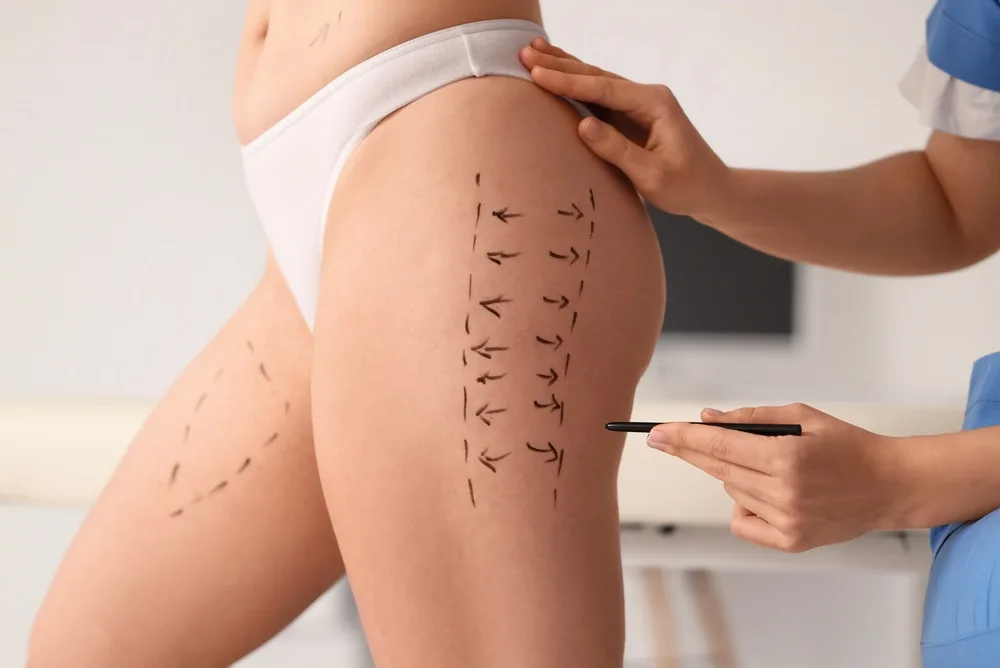
Significant weight loss can transform your health and body, yet the skin along your thighs may not shrink around your new shape. Aging, genetics, and previous weight changes can also leave the inner or outer thighs looking loose, folded, or out of proportion with the rest of your figure. You may have built stronger legs and maintained a stable weight, but exercise cannot tighten skin that has lost much of its elasticity. In some cases, the excess tissue also rubs while walking, traps moisture, causes irritation, or makes fitted clothing uncomfortable.
A thigh lift, also called thighplasty, is a body contouring procedure that removes excess skin and selected fat to create smoother, firmer thigh contours. Depending on where the looseness is located, surgery may focus on the inner thighs, outer thighs, or a more extensive portion of the upper legs. The operation is not designed for major weight loss or muscle building. Instead, it addresses loose tissue that remains after your body has reached a reasonably stable size.
At Women’s LifeCenter Aesthetic Surgery and Medispa, Elysa Fisher, MD, FACS, begins by determining whether your concern comes primarily from skin, fat, or both. She also considers how the thighs relate to the hips, knees, abdomen, buttocks, and overall lower-body proportions. Her goal is not to make your legs look unnaturally tight or create someone else’s shape. It is to help your thighs feel smoother, more balanced, and better connected to the progress you have already made.
Schedule a Complimentary Consultation
When Weight Loss Leaves Something Behind
Losing a significant amount of weight can be one of the most meaningful accomplishments in a person’s life. However, the emotional experience becomes complicated when excess skin remains after the scale has changed. You may feel healthier, stronger, and more mobile, yet still arrange your clothing around loose inner-thigh tissue or avoid shorts because the skin does not reflect the body beneath it. That frustration does not erase pride in your progress, and wanting to address the remaining skin does not make the accomplishment less meaningful.
Loose thigh skin can also become a physical concern. Folds may rub together during walking or exercise, particularly in warm weather. Moisture can collect within the creases, and clothing may pull, bunch, or fit differently between the waist and legs. Cleveland Clinic notes that thigh lift surgery may improve contour while also relieving pain and irritation caused by thighs that continually rub against each other.
Clients often describe trying to solve the problem through more exercise, hoping stronger muscles will fill or tighten the skin. Exercise can improve strength, endurance, and muscle definition, but it cannot remove excess tissue or fully restore lost elasticity. In fact, building stronger legs may make the contrast between the underlying muscle and loose surface skin feel more noticeable. A thigh lift addresses the skin and soft tissue that fitness cannot directly change.
What Is Thigh Lift Surgery?
A thigh lift reshapes the upper legs by removing excess skin and, when appropriate, selected fat. The remaining tissue is repositioned and supported to create a smoother contour. Because the amount and location of looseness differ considerably, thighplasty is not one standardized operation performed the same way for every client.
Some clients have looseness concentrated near the groin and upper inner thigh. Others have skin extending farther down the inner leg, sometimes approaching the knee. Outer-thigh laxity may be connected to changes around the hip, buttock, or lower torso and can require a different incision and lifting direction. Dr. Fisher evaluates each region separately before deciding what type of correction may be appropriate.
Thigh lift surgery may include limited fat reduction, but it is not simply an extensive form of liposuction. Liposuction reduces fat through small access points, while a lift removes loose skin and reshapes the remaining tissue. When skin elasticity is poor, fat removal alone may leave the area looking even less supported. The American Society of Plastic Surgeons notes that liposuction may be sufficient when skin can naturally conform, while a thigh lift with liposuction may be considered when poor elasticity and excess fat occur together.
What Can a Thigh Lift Improve?
Thigh lift surgery may create a smoother transition across the upper legs and reduce folds that remain after weight loss or aging. The degree of improvement depends on how much tissue is present, where it is located, and how your body heals. Surgery cannot guarantee perfectly smooth skin or identical thighs. However, it may provide a meaningful change when loose tissue is the main concern.
A thigh lift may be considered for:
- Loose inner-thigh skin after significant weight loss
- Upper-thigh tissue that sags or folds
- Skin that rubs, chafes, or becomes irritated
- Excess tissue that makes exercise uncomfortable
- Outer-thigh laxity connected to the hips or lower body
- Thighs that remain out of proportion with a smaller frame
- Clothing that pulls or gathers around loose tissue
- Skin that does not tighten despite stable weight and regular exercise
- Selected fat removed as part of a planned surgical contour
- Differences between the thighs that may be improved, although not eliminated
A thigh lift does not directly treat cellulite. Cellulite is created partly by fibrous bands connecting the skin to deeper tissue, not simply by excess fat or loose skin. Removing skin or fat may change the surface, but dimpling can remain and may occasionally become more visible after the contour changes. Liposuction is also not considered a reliable cellulite treatment.
Inner or Medial Thigh Lift
An inner thigh lift, also called a medial thigh lift, targets excess tissue along the inside of the upper legs. This is a common concern after substantial weight loss because the skin may hang vertically or gather near the groin. The tissue may rub during walking and make fitted pants, exercise wear, or swimwear difficult to wear comfortably. A medial thigh lift removes selected skin and redirects the remaining tissue upward or inward to create a smoother contour.
For limited looseness near the upper thigh, the incision may be placed within or near the groin crease. This approach can sometimes conceal much of the scar beneath underwear or swimwear, although concealment depends on clothing style and anatomy. It cannot correct extensive skin that continues far down the leg. Attempting to treat a long area of laxity through a very short incision may create tension, incomplete correction, or distortion near the groin.
When looseness extends toward the knee, a vertical incision along the inner thigh may be required. Some procedures combine a groin incision with a vertical incision to address skin in more than one direction. The American Society of Plastic Surgeons describes inner-thigh techniques ranging from a limited groin incision to an incision extending along the inseam toward the knee.
Outer Thigh Lift
An outer or lateral thigh lift addresses laxity along the outside of the thighs and may also affect contours near the hips and buttocks. Outer-thigh looseness is often connected to a broader pattern of lower-body tissue descent rather than an isolated fold along the leg. As a result, surgery may require an incision extending from the groin around the hip or toward the back.
This approach should not be confused with an inner thigh lift. The lifting direction, incision placement, and tissue being addressed are different. A client with inner-thigh rubbing may receive little benefit from an operation designed primarily for the outer thigh. Likewise, someone with lateral laxity may not achieve the desired shape through an inner-thigh procedure.
In more extensive cases, outer-thigh correction may be considered as part of a lower body lift. A lower body lift can address related laxity around the abdomen, waist, groin, buttocks, and thighs through a broader surgical plan. This type of operation involves longer incisions and a more involved recovery, so Dr. Fisher will determine whether one focused thigh procedure or a staged body contouring plan is more appropriate.
Limited Versus Vertical Thigh Lift Incisions
Many clients hope to receive the smallest possible scar, which is completely understandable. However, scar length must be matched to the amount and direction of loose tissue. A shorter incision can work when laxity is concentrated near the groin, but it cannot reliably remove skin extending down most of the inner leg. Choosing a procedure based only on scar length may leave the main concern untreated.
A vertical inner-thigh incision is more visible, particularly when the legs are apart or viewed from certain angles. However, it can remove a greater amount of tissue along the length of the leg. For a client whose loose skin reaches toward the knee, accepting a longer scar may provide a more complete and balanced improvement. Dr. Fisher will help you compare the likely contour change with the location and visibility of the incision.
The scar discussion should happen before surgery, not after the procedure has been chosen. You should understand where the incision is expected to begin and end, whether it may be visible in shorts or swimwear, and how your personal healing history could affect its appearance. Thigh lift scars are permanent, even though they generally fade and soften with time.
Thigh Lift Versus Liposuction
Liposuction may be appropriate when fullness comes from localized fat and the skin remains firm enough to contract after the volume is reduced. It can refine the thighs through smaller access incisions, but it does not remove a meaningful amount of loose skin. When laxity is already present, reducing the fat beneath it may leave the skin hanging more noticeably.
A thigh lift is usually more appropriate when the main concern is sagging, folding, or excess tissue. Skin is removed directly, and the remaining tissue is repositioned. The tradeoff is a larger incision and a more demanding recovery. The choice is therefore not simply between an easy procedure and a difficult one, but between two treatments designed to solve different structural problems.
Some clients benefit from combining a thigh lift with carefully limited liposuction. The lift can address skin while fat reduction improves selected areas of fullness that would otherwise interrupt the contour. However, aggressive liposuction can affect circulation and healing, especially near long skin-removal incisions. Dr. Fisher will recommend a combination only when each part has a clear purpose and can be included responsibly.
Am I a Candidate for Thigh Lift Surgery?
A suitable candidate is generally in good overall health, at a reasonably stable weight, and bothered by excess inner- or outer-thigh tissue. Candidates should not have uncontrolled medical conditions that significantly impair healing or increase surgical risk. They should also avoid smoking and nicotine and have realistic expectations about scars, recovery, and the degree of change surgery can provide.
You may be ready to discuss a thigh lift if:
- Your weight has remained reasonably stable
- Loose thigh skin has not improved through exercise
- Your thighs rub, chafe, or become irritated
- You understand that surgery leaves permanent scars
- You can stop cigarettes, vaping, and other nicotine products as directed
- You can arrange help during the beginning of recovery
- You can accommodate restrictions on walking, lifting, and exercise
- You are committed to maintaining your health and weight
- Your goal is meaningful improvement rather than perfect skin
- You are choosing surgery for yourself
If you are still actively losing a significant amount of weight, it may be better to wait. Additional weight loss can create more loose skin and change how much tissue should be removed. Weight gain after surgery can also stretch the result and place additional tension on scars. Dr. Fisher will review your weight history, current nutrition, and future goals before recommending timing.
Your Consultation With Dr. Elysa Fisher
Your consultation begins with the concerns you experience in real life. Dr. Fisher will ask whether the tissue rubs while walking, affects exercise, changes the way clothing fits, or primarily bothers you visually. She will also ask about weight changes, pregnancies, bariatric procedures, previous body contouring, medical conditions, medications, nicotine use, and any history of wound-healing problems. A complete and honest history is important because the safety of thigh surgery depends on more than the appearance of the legs.
During the examination, Dr. Fisher evaluates the inner and outer thighs while you are standing. She considers skin elasticity, fat distribution, the direction of laxity, existing scars, leg proportions, and the relationship between the thighs, knees, hips, buttocks, and lower torso. Measurements and medical photographs may be taken to support planning. This examination determines whether a limited inner-thigh lift, a longer vertical correction, outer-thigh treatment, liposuction, or another body contouring approach may be appropriate.
Dr. Fisher completed her undergraduate, graduate, and postgraduate education at Northwestern University and has been board-certified in plastic surgery since 1992. She describes her role as being accessible and serving as a source of information for clients considering both surgical and non-surgical care. Her philosophy emphasizes safe treatment, clear education, and understanding women’s experiences within a welcoming environment.
You should leave the consultation knowing what type of improvement is realistic, where the scars are likely to be located, and how recovery may affect your routine. Dr. Fisher will also explain whether treating one area could leave another region out of balance. In some cases, a thigh lift may be appropriate on its own. In others, a staged body contouring plan may create a safer or more complete result.
Preparing for Thigh Lift Surgery
Preparation may include laboratory testing, medical evaluation, medication review, and instructions about eating, drinking, bathing, and arriving for surgery. Some medications and supplements can increase bleeding, but you should never stop a prescribed treatment unless the clinician managing it approves the change. Surgery should take place in an appropriately accredited or licensed surgical setting.
Nicotine use must be discussed honestly because nicotine restricts blood flow to healing tissue. Long thigh incisions are exposed to movement, moisture, and tension, so impaired circulation can significantly increase the risk of wound separation or skin loss. Cigarettes, vaping products, nicotine pouches, gum, and patches may all matter. Follow Dr. Fisher’s instructions about stopping before and after surgery rather than substituting one nicotine product for another.
You will need an adult to drive you home and remain with you for the initial period Dr. Fisher recommends. Prepare loose clothing, easy meals, approved medications, and a recovery area that limits unnecessary stairs. You may also need help with pets, children, laundry, shopping, and household tasks. Planning for assistance is especially important because even ordinary walking places movement and tension across the inner thighs.
What Happens During Thigh Lift Surgery?
Thigh lift surgery may be performed with intravenous sedation or general anesthesia, depending on the procedure and surgical plan. Dr. Fisher creates the planned incisions and removes a carefully measured amount of excess skin and tissue. Deep sutures may be used within the supporting tissue to help shape and hold the new contour. The skin is then closed with sutures, adhesive, clips, or another appropriate method.
For a limited inner thigh lift, the incision may remain near the groin. A more extensive procedure may require an incision extending down the inner leg, while an outer-thigh lift may involve an incision around the hip. The amount removed must be balanced carefully because too much tension can pull on the groin, widen the scar, or interfere with healing.
Dressings and compression may be placed after the incisions are closed. Small temporary drains may also be used to remove fluid or blood that collects beneath the skin. You will receive specific instructions about drain care, incision care, medications, movement, bathing, compression, and symptoms that require immediate contact with the office.
Thigh Lift Recovery
Thigh lift recovery requires patience because almost every step creates movement near the surgical area. Swelling, bruising, tightness, soreness, numbness, and fatigue are expected during the early period. Walking may feel stiff or restricted, and sitting can place pressure on groin or upper-thigh incisions. The exact experience depends on whether you had a limited upper-thigh procedure or a longer vertical correction.
Gentle movement may be encouraged to support circulation, but excessive motion, friction, and force can interfere with healing. The American Society of Plastic Surgeons emphasizes protecting incisions from excessive force, swelling, abrasion, and movement. You will need to follow Dr. Fisher’s walking, sleeping, sitting, and activity instructions closely rather than trying to resume normal routines as soon as discomfort begins improving.
Recovery time varies significantly according to the technique. Some clients return to lighter routines within several weeks, while extensive inner-thigh procedures can require a longer period before walking and ordinary movement feel comfortable. A 2026 ASPS discussion notes that recovery from extensive inner-thigh lifting may be particularly demanding, with some clients needing six to eight weeks before standard or brisk walking feels comfortable.
Work requirements also matter. Someone working from home may return sooner than a client who stands, walks, climbs stairs, or performs physical care throughout the day. Even after returning to work, swelling and fatigue may increase with activity. Dr. Fisher will provide a timeline based on your procedure rather than a general promise that applies to every thigh lift.
Thigh Lift Scars
Thigh lift scars are permanent and may be significant. A limited inner-thigh lift may leave a scar near the groin crease, while a vertical thigh lift can leave a line along the inner leg. Outer-thigh surgery may create scars extending around the hip or toward the back. Although incisions are placed strategically when possible, extensive tissue removal requires extensive access.
Early scars may appear red, dark, raised, firm, or uneven. They generally soften and fade as the tissue matures, but complete disappearance cannot be promised. Some people naturally develop wider, darker, or thicker scars despite careful surgery and aftercare. A history of keloids or difficult scarring should be discussed before surgery.
The thigh is a challenging location because walking, sitting, clothing, moisture, and friction can place stress on healing incisions. Following activity restrictions and incision-care instructions can help reduce avoidable problems, but it cannot control every aspect of healing. The decision to have surgery should therefore include an honest comparison between the contour improvement and the scars required to create it.
Results and Long-Term Changes
A smoother thigh contour is visible relatively soon after surgery, although swelling and bruising initially hide the final shape. The tissues continue settling over several months, and one leg may improve at a different rate than the other. Some numbness, firmness, or uneven swelling can remain after you feel ready to return to ordinary activities.
Results can be long-lasting when weight remains stable and general fitness is maintained. However, the body continues aging, and the remaining skin may gradually lose some firmness. Significant weight gain or loss can also change the contour and stretch the tissues again. Most of the initial improvement should remain, but no operation can permanently stop gravity or skin aging.
A successful result should improve proportion and reduce the excess tissue that interfered with comfort or confidence. It should not make the legs look unnaturally tight or remove every small fold and surface variation. In some cases, more than one procedure may be necessary to achieve the safest or most complete result.
Risks and Important Considerations
Thigh lift surgery involves meaningful risks because it requires long incisions in an area exposed to movement and tension. Possible complications include bleeding, infection, seroma, fat necrosis, poor wound healing, major wound separation, skin loss, numbness, persistent pain, asymmetry, discoloration, recurrent laxity, unfavorable scars, and the possible need for revision surgery. Blood clots and heart or lung complications are also recognized risks.
The location of the incision creates additional practical concerns. A groin scar may widen or migrate downward as the tissues heal. Swelling may take time to resolve, and one side may appear temporarily tighter or higher. Internal or external sutures can also become visible, irritated, or require removal.
No responsible surgeon can guarantee a complication-free recovery or perfectly identical thighs. Dr. Fisher will explain which risks are most relevant to your health and the planned technique. Avoiding nicotine, attending follow-up visits, maintaining appropriate nutrition, protecting the incisions, and reporting concerns promptly are important parts of reducing preventable problems.
Seek immediate medical attention for chest pain, shortness of breath, unusual heartbeats, or another urgent symptom. Contact the office for worsening pain, sudden swelling, fever, increasing redness, unusual drainage, skin color changes, wound separation, or symptoms identified in your postoperative instructions. Early communication allows a concern to be evaluated before it becomes more difficult to treat.
Why Choose Dr. Elysa Fisher for Thigh Lift Surgery in Wilmette?
Thigh lift surgery requires more than removing the greatest possible amount of skin. The surgeon must understand how the incision will behave during walking, where tension will collect, how fat and skin contribute to the contour, and how the thighs relate to the rest of the lower body. Dr. Fisher brings decades of plastic surgery experience and a Northwestern education to that planning. She has been board-certified in plastic surgery since 1992.
Women’s LifeCenter Aesthetic Surgery and Medispa was created around Dr. Fisher’s belief that women deserve access to information, healing, and personalized options in one welcoming place. She understands that body contouring concerns may be connected to weight loss, pregnancy, aging, physical irritation, or years of feeling uncomfortable in clothing. Her role is not to tell you which parts of your body should change. It is to help you understand what surgery can realistically improve and whether the tradeoffs make sense for you.
Clients featured on the practice’s website describe Dr. Fisher as compassionate, detailed, accessible, and attentive during follow-up care. They also speak about feeling comfortable with the staff and having individual sensitivities taken seriously. Those qualities matter during thigh lift recovery, when swelling, scars, movement restrictions, and wound care may require ongoing communication rather than a one-day surgical interaction.