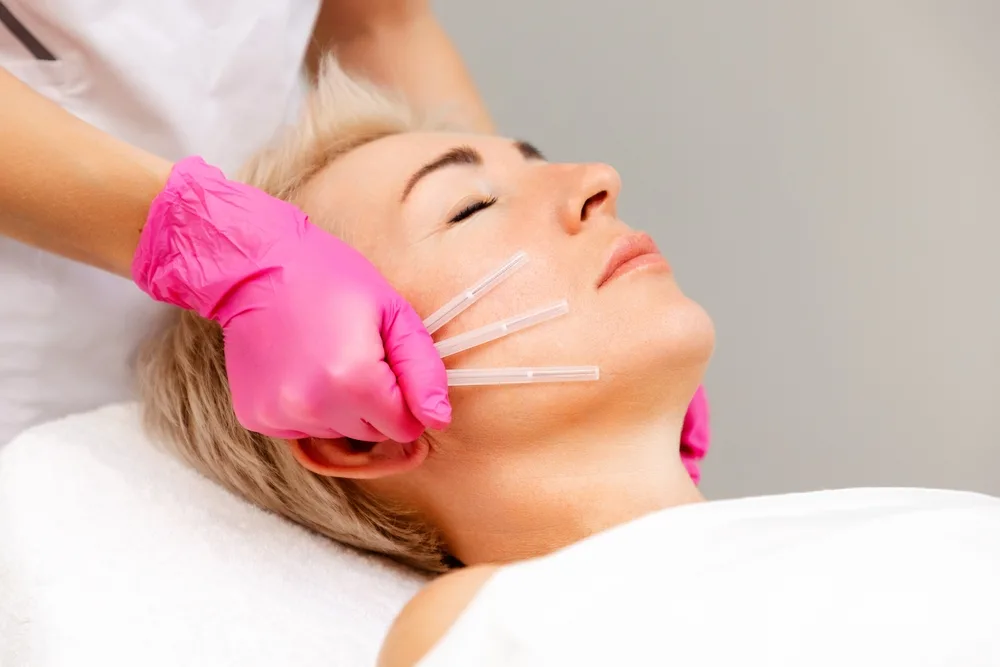
Facial aging does not always begin with deep wrinkles. Sometimes the first change is a softer jawline, a cheek that sits slightly lower, or a small amount of looseness that changes the way light moves across your face. You may still recognize yourself, yet feel that your features look more tired or less defined than they did a few years ago.
A PDO thread facelift is a minimally invasive treatment that places absorbable sutures beneath the skin to support and reposition selected facial tissue. It may create a subtle lifting effect without the incisions, general anesthesia, or recovery associated with facelift surgery. However, a thread lift cannot remove excess skin or reproduce the degree of correction possible with a surgical facelift. The best results come from choosing it for the right concern rather than expecting it to act like surgery.
At Women’s LifeCenter Aesthetic Surgery and Medispa, Elysa Fisher, MD, FACS, evaluates the entire face before recommending PDO thread treatment. Dr. Fisher considers skin quality, tissue position, facial volume, bone structure, symmetry, and the amount of looseness present. Her goal is not to pull the face into an unfamiliar shape. It is to determine whether a measured lift can restore definition while preserving the expressions and features that still feel like you.
Schedule a Complimentary Consultation
When Your Face Has Changed, but You Are Not Ready for Surgery
Many clients interested in PDO threads are not looking for a dramatic transformation. They may notice early jowling in photographs, a less distinct border between the face and neck, or cheeks that no longer have the same gentle elevation. The change may be modest, but because it affects facial shape, it can feel more noticeable than a single wrinkle.
Our clients often describe this stage as being caught between treatments. Skincare may improve brightness and texture, while injectables may soften lines or restore selected volume. However, neither option physically repositions loose tissue in the same way as a lifting procedure. At the same time, the client may not have enough laxity to justify facelift surgery or may not be prepared for a surgical recovery.
A PDO thread facelift may help fill that narrow space between surface treatments and surgery. The improvement is generally subtle and temporary, which can be appropriate when facial aging is still relatively early. It is not the right answer for everyone, but for a carefully selected client, it may create a refreshed contour without changing the essential character of the face.
What Is a PDO Thread Facelift?
PDO stands for polydioxanone, a synthetic material used to make absorbable surgical sutures. During a thread lift, specialized threads are placed beneath the skin through small entry points. Depending on the design, the threads may include tiny barbs that engage the surrounding tissue and allow it to be repositioned in a controlled direction.
The treatment works in two related ways. First, the thread provides a mechanical support that may lift selected tissue immediately. Second, the presence of the absorbable material creates a healing response around the treatment path, which may encourage collagen formation as the threads gradually dissolve. Collagen supports the skin’s structure, although the degree and duration of collagen-related improvement vary among clients.
PDO thread systems are not all identical. They vary in length, thickness, barb pattern, needle or cannula design, and intended use. Some FDA-cleared PDO suture systems include an indication for temporary facial suspension, while others are cleared only for general soft-tissue approximation. Therefore, the safety and regulatory status of a treatment must be evaluated according to the specific device being used, not simply because the material is called PDO.
What Can PDO Threads Improve?
A thread lift is best suited to early or moderate changes that can be improved through subtle tissue repositioning. It may be used to create more definition along selected facial contours, but the amount of correction is limited by skin quality, tissue weight, facial structure, and the direction in which the tissue has descended. A treatment plan should focus on one or two meaningful improvements instead of attempting to tighten every part of the face.
Depending on your anatomy and the specific thread system used, treatment may be considered for:
- Early jowling along the lower face
- Mild loss of jawline definition
- Slight descent of the cheeks
- Selected folds caused partly by downward tissue movement
- Mild looseness along the upper neck
- A brow that may benefit from subtle elevation
- Facial asymmetry that can be improved through careful support
- Early skin laxity after a previous facial procedure
Not every area is appropriate for every client or every thread. The cheeks, lower face, jawline, brow, and neck have different tissue thicknesses, blood vessels, nerves, and patterns of movement. Dr. Fisher will determine whether threads can be placed safely and whether the expected lift is meaningful enough to justify the procedure.
What a Thread Facelift Cannot Do
The term “thread facelift” can create unrealistic expectations. Although PDO threads can provide a visible lift, they do not remove hanging skin, reposition the deeper facial structures as extensively as surgery, or permanently correct advanced jowling and neck laxity. A surgical facelift remains capable of producing a greater and more durable change because excess skin can be removed and deeper tissues can be repositioned directly.
Threads also do not replace volume that has been lost from the temples, cheeks, lips, or area around the mouth. If facial hollowing is the primary concern, a dermal filler or another volume-restoring treatment may be more appropriate. Likewise, threads do not directly soften expression lines created by muscle movement, which may respond better to a neuromodulator such as Xeomin.
Surface concerns require another approach as well. PDO threads will not remove brown spots, repair sun damage, clear congested pores, or resurface rough skin. Microneedling, professional peels, medical-grade skincare, or another skin treatment may be discussed when tone and texture are contributing to an aged appearance.
Who Is a Good Candidate for PDO Thread Treatment?
A good candidate usually has mild to moderate tissue laxity, relatively good skin quality, and realistic expectations about a temporary, subtle result. Thread lifts are often considered by adults experiencing early facial aging who do not want surgery or are not yet ready for the extent of correction a facelift provides. The treatment is less likely to be satisfying when there is heavy tissue, advanced sagging, substantial excess skin, or an expectation of dramatic tightening.
You may be ready to discuss a PDO thread facelift if you:
- Want a modest lift rather than a dramatic transformation
- Are bothered by early jowls or reduced facial definition
- Understand that the result is temporary
- Prefer local anesthesia and a shorter recovery than surgery
- Can follow restrictions while the threads settle
- Accept the possibility of bruising, swelling, dimpling, or asymmetry
- Are willing to discuss all prior fillers, threads, lasers, and facial surgery
- Have realistic expectations about what a minimally invasive procedure can accomplish
Medical history remains important even though this is not traditional surgery. Dr. Fisher needs to know about bleeding disorders, autoimmune conditions, infections, allergies, medications, supplements, nicotine use, prior facial procedures, dental work, and problems with wound healing. Pregnancy, breastfeeding, active skin inflammation, or an infection near the planned treatment area may require postponing the procedure.
PDO Threads Versus Dermal Fillers
PDO threads and dermal fillers are sometimes grouped together because both can be performed without traditional surgery. However, they solve different problems. Threads are intended to support or reposition tissue, while fillers add volume to areas that have become hollow or need greater structural support.
Consider a client whose lower cheek has descended slightly but who still has adequate facial volume. Adding filler without considering the tissue position could make the lower face appear heavier. In that situation, a subtle lift may be more useful than additional volume. By contrast, a client with flat cheeks and good skin position may benefit more from carefully placed filler than from threads.
Some clients may benefit from both treatments, but combination care should be planned conservatively. The goal is not to keep adding products until the face looks tight or full. Dr. Fisher evaluates where support has been lost, where volume has been lost, and how each proposed treatment may affect the balance of the entire face.
PDO Threads Versus a Surgical Facelift
A PDO thread lift uses absorbable sutures placed through small entry points and is generally performed with local anesthesia. Recovery is usually shorter, and the result is more limited and temporary. A surgical facelift requires incisions and a more involved recovery, but it allows the surgeon to reposition deeper tissue and remove excess skin.
A client with early jowling and good skin elasticity may be pleased with the smaller change provided by threads. A client with hanging neck skin, heavy jowls, or significant lower-face laxity may spend money and recovery time on threads without receiving the improvement she expects. In that situation, surgery may offer a more honest solution.
Choosing threads simply because surgery feels intimidating can lead to disappointment when the anatomy requires a surgical correction. Dr. Fisher provides both surgical and non-surgical care, so she can compare the options without asking PDO threads to perform beyond their limits. Sometimes the right recommendation is a thread lift. Sometimes it is a facelift, another treatment, or waiting until the concern becomes more significant.
Your Consultation With Dr. Elysa Fisher
Your consultation begins with what you have noticed and how much change you hope to see. Dr. Fisher will examine your face while it is relaxed and in motion, paying attention to the brows, cheeks, jawline, neck, skin thickness, volume, symmetry, and facial proportions. She will also ask which views bother you most because a concern that appears along the profile may require a different plan than one visible from the front.
Medical photographs may be taken to document your starting point and help with planning. Dr. Fisher will review previous fillers, neuromodulators, lasers, energy treatments, threads, and facial surgery because those treatments may change the tissue beneath the skin. A complete history matters even when a product was placed years ago or you believe it has fully disappeared.
Dr. Fisher completed her undergraduate, graduate, and postgraduate education at Northwestern University and has been board-certified in plastic surgery since 1992. She describes her role as being accessible and serving as a source of information, whether a client is considering a simple office treatment or a surgical procedure. That perspective is especially useful for thread lifts because careful selection often matters more than the procedure itself.
You should leave the consultation understanding what the threads may improve, where they will be placed, how long the result may last, and what can go wrong. Dr. Fisher will also explain whether another procedure is more likely to achieve your goal. The purpose is not to persuade you to select the least invasive treatment. It is to help you choose the treatment that best matches the change you actually want.
What Happens During a PDO Thread Facelift?
The procedure is typically performed in the office using local anesthesia. Your face is cleansed, the treatment direction is mapped, and anesthetic is used to improve comfort around the planned entry points and thread paths. You remain awake during the procedure, although you may feel pressure or movement as the threads are positioned beneath the skin.
A needle or cannula is used to guide each thread into the planned tissue layer. Once positioned, barbs along the thread engage the surrounding tissue so it can be elevated in a controlled direction. Dr. Fisher evaluates facial balance throughout the procedure rather than assuming both sides require identical placement.
The appointment may take about an hour, although timing varies according to the number of areas and threads involved. Small entry points are used instead of surgical facelift incisions. You can generally return home after treatment, but you should follow the transportation and activity instructions provided specifically for you.
Recovery and Aftercare
Swelling, bruising, soreness, tightness, temporary dimpling, and mild irregularity can occur during early recovery. Some clients feel the threads when making larger facial movements, chewing, or touching the area. These effects often improve as swelling settles and the tissues begin adapting to their new position.
Many people feel comfortable returning to public activities within several days, although the face may not look fully settled for a few weeks. The American Society of Plastic Surgeons notes that clients are often presentable within three to five days, while Cleveland Clinic reports that swelling and bruising may last up to about five days. Individual recovery can be longer, particularly when several areas are treated or bruising is more noticeable.
You may need to sleep with your head elevated and avoid sleeping directly on the treated side. Vigorous rubbing, facial massage, strenuous exercise, dental procedures, wide mouth movements, and pressure from tight equipment may be restricted while the threads settle. Dr. Fisher will give you instructions based on the areas treated and the thread system used, so those directions should take priority over general advice found online.
Our clients often tell us that detailed instructions make an unfamiliar treatment feel much less stressful. Dr. Fisher’s existing clients repeatedly describe her as thorough, accessible, and willing to answer questions before and after a procedure. They also describe the office as calm and welcoming, which can be reassuring when normal swelling or temporary unevenness makes the early result feel unfamiliar.
When Will You See Results?
Some lifting may be visible immediately because the threads physically support the tissue. However, swelling and temporary skin puckering can make the early result difficult to judge. The contour generally becomes easier to evaluate as the tissues settle over the following days and weeks.
Results are temporary. Cleveland Clinic describes thread lift effects as lasting approximately one to three years, while more recent medical literature notes that long-term effectiveness data for absorbable facial threads remain limited. Duration depends on the device, number and placement of threads, skin quality, tissue weight, age, healing response, and natural progression of facial aging.
The threads themselves are designed to absorb, but the appearance does not necessarily disappear on the exact day the material dissolves. Collagen and tissue changes around the treatment path may contribute to continued support for a period. Still, no responsible provider can promise a specific number of months or years before examining you.
Maintenance treatment may be considered after the effect fades, but repeating threads indefinitely is not automatically the best plan. Previous threads may affect the tissue layers encountered during later treatment or surgery. Dr. Fisher will help you decide whether another thread lift, a different non-surgical treatment, or facelift surgery makes more sense as your face continues to change.
Risks and Possible Complications
A PDO thread facelift is minimally invasive, but it is not risk-free. Expected short-term effects may include swelling, bruising, tenderness, tightness, temporary dimpling, and visible entry points. Other complications can include infection, persistent pain, asymmetry, palpable or visible threads, contour irregularity, thread migration, extrusion through the skin, and an unfavorable cosmetic result.
A 2026 meta-analysis of 26 studies involving 2,827 clients found that reported complications included swelling, bruising, visible or palpable threads, and skin dimpling, although rates varied across studies and techniques. Anatomical research also emphasizes the importance of avoiding facial nerves and blood vessels and placing threads within the appropriate tissue plane.
Infection may require antibiotics, drainage, or removal of the affected thread. A thread that becomes visible, palpable, displaced, or exposed through the skin may also require further treatment. Although many complications are temporary or treatable, some can persist and may affect future facial procedures.
Call the office promptly if you develop increasing redness, warmth, drainage, worsening pain, fever, new weakness, significant asymmetry, skin color changes, or a thread that becomes exposed. Early communication gives Dr. Fisher the best opportunity to evaluate what is happening. You should never attempt to push, pull, cut, or reposition a thread yourself.
Why Choose Dr. Elysa Fisher for PDO Threads in Wilmette?
Thread lifting depends on a detailed understanding of facial anatomy. The provider must know where nerves and blood vessels travel, which tissue layer can support the thread, and how the direction of pull will affect facial balance. The procedure also requires the judgment to recognize when a client is unlikely to benefit.
Dr. Fisher brings the perspective of a board-certified plastic surgeon with decades of experience evaluating facial aging. She completed her undergraduate, graduate, and postgraduate education at Northwestern University and became board-certified in plastic surgery in 1992. Her training allows her to compare PDO threads with injectables, skin treatments, minimally invasive procedures, and facial surgery rather than treating threads as the answer to every form of laxity.
Women’s LifeCenter Aesthetic Surgery and Medispa was created around the belief that women deserve a supportive place to understand their options and make choices about their well-being and self-esteem. Dr. Fisher combines technical precision with accessibility, and she believes clients should understand what a treatment can achieve as well as where it falls short.
Clients describe Dr. Fisher as compassionate, detailed, warm, and willing to spend time answering their questions. They also describe feeling at ease in an office where their sensitivities and individual concerns were taken seriously. That relationship matters with a treatment whose best outcome often depends on conservative planning rather than the greatest possible pull.